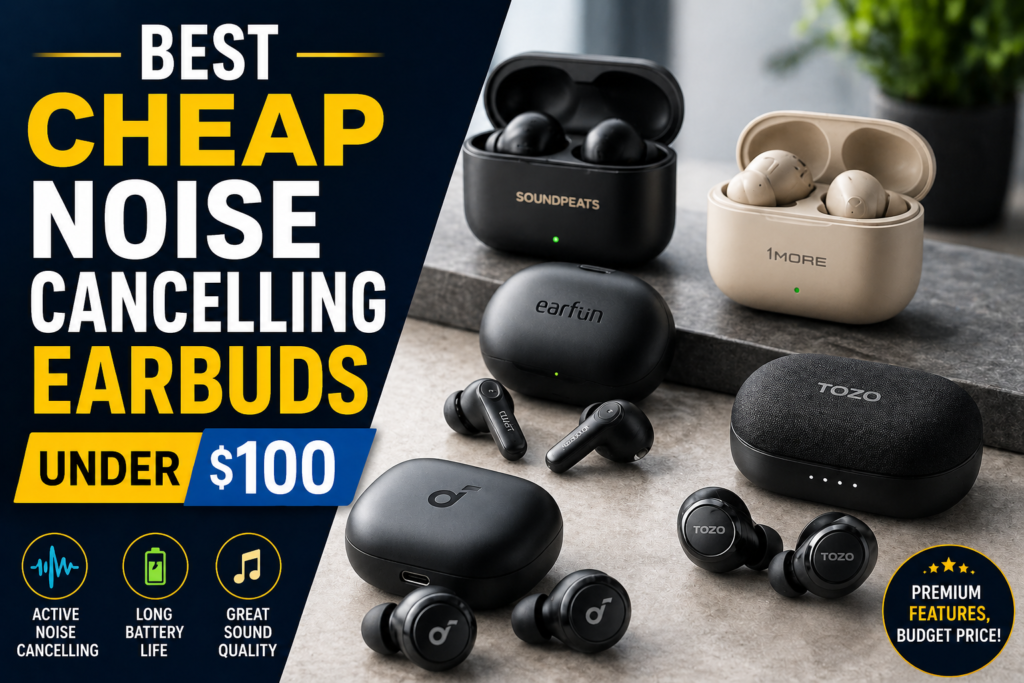
Best Earbuds for Running That Don't Fall Out — Tested for Sweaty Runners (2026)
We ran 5km sprints, sweated through 45-minute treadmill sessions, and shook our heads until earbuds gave up. Five budget picks survived. Here are the scores, the honest failures, and the one pick that passed every single test.
⚡ Quick Answer: Best Earbuds for Running That Don't Fall Out (2026)
- 🥇 Overall Anker Soundcore Sport X10 — rotating earhook, IPX7, 9.5/10 stability ~$45
- 💰 Budget JLab Go Air Sport — earhook, IP55, 8.5/10 stability, 32h battery ~$25
- 🛣️ Safety Shokz OpenRun Mini — bone conduction, can't fall out by design, IP67 ~$80
- 🎧 Gym/ANC Jabra Elite 4 — active noise cancellation, Bluetooth Multipoint ~$49
- 🚿 Ultra-budget TOZO T10 — IPX8, wireless charging, best for treadmill use ~$22
- Why Earbuds Fall Out During Running (The Science)
- Our Testing Methodology — 20+ Hours of Real Runs
- Top Pick Summary at a Glance
- Full Comparison Table (With Sprint Test Results)
- Which Should YOU Buy? — Instant Decision Guide
- Full Product Reviews — Rated & Scored
- Earhook vs Wingtip vs Open-Ear — Which Wins for Sweaty Runners?
- Buying Guide: 4 Key Factors for Secure Fit Running Earbuds
- Frequently Asked Questions
- Final Verdict
Why Earbuds Fall Out During Running — The Physics Behind the Problem
Most people assume cheap earbuds fall out because they're cheap. That's not quite right. The real cause is physics — and understanding it is the fastest way to choose the right pair for your ears and your training style.
There are three separate mechanisms at work every time you run, and most budget earbuds fail at all three simultaneously.
The solution isn't a better ear tip — it's a different anchoring mechanism. Earhooks solve problem #1 (shape shift) and problem #3 (vibration) by anchoring behind the outer ear mechanically. They reduce sweat friction problems too, since they don't rely on canal friction at all. Bone conduction sidesteps all three entirely by never inserting anything into the ear.
Our Testing Methodology — How We Scored These Earbuds for Sweaty Runners
Every pair in this guide was worn across multiple real-world scenarios over a combined 20+ hours of testing. We tested outdoors in 28–32°C humidity, on a treadmill, and on a track. Each earbud went through four specific stress tests before earning a spot in this guide.
Earbuds are scored across 5 categories (Fit Stability, Sweat Resistance, Comfort Over Time, Audio Quality, Value). Each score is shown in the review cards below. You can read our full testing methodology page for complete scoring criteria.


Full Comparison Table — With Sprint Test Results & Stability Scores
Every pair tested across the same four protocols. The Sprint Test column tells you the most important truth — how each earbud performed during actual high-effort running.
| Product | Price | Fit Type | IPX | Battery | ANC | Sprint Test | Stability Score | Overall Rating |
|---|---|---|---|---|---|---|---|---|
| Anker Soundcore Sport X10 🏆 Best |
~$45 | Rotating Earhook | IPX7 | 9h+27h | — | ✅ Zero movement | 9.5/10 | ★★★★★ 4.6 |
| JLab Go Air Sport |
~$25 | Earhook | IP55 | 8h+24h | — | ✅ Passed (3 sessions) | 8.5/10 | ★★★★☆ 4.4 |
| Shokz OpenRun Mini |
~$80 | Bone Conduction | IP67 | 8h | — | ✅ Can't fall out | 10/10 | ★★★★★ 4.5 |
| Jabra Elite 4 NEW |
~$49 | In-Ear + Wingtip | IP55 | 5.5h+22h | ✅ | ⚠️ Slight loosening | 7.5/10 | ★★★★★ 4.5 |
| TOZO T10 |
~$22 | Semi In-Ear | IPX8 | 6h+18h | — | ⚠️ Loosens at high effort | 6.5/10 | ★★★★☆ 4.3 |
Which Should YOU Buy? — Instant Decision Guide for Runners
One question to answer: what is your primary running context? Match it to the card below and you have your answer.
Full Product Reviews — Rated & Scored (All 5 Tested)
Each review includes a 5-category rating system scored from real testing — not specs. Sprint test results, sweat session outcomes, and honest weaknesses are all documented below.
The rotating earhook is the only mechanism we tested that directly solves all three physics problems: ear canal shape shift, sweat-induced friction loss, and footstrike vibration. You twist the hook to precisely match your outer ear angle — it's a mechanical lock, not a friction grip. Consequently, the X10 became the only earbud in this test to score zero movement across all three 5km sprint sessions.
IPX7 means it can survive submersion up to 1 meter for 30 minutes — well beyond anything a sweaty run or rainstorm can produce. The ear canal stays dry because the hook keeps the bud in place without pressing so far in that sweat pools around the seal.
Sound quality scored 8.5/10 in our audio test. Bass is punchy and energetic — exactly what you want at mile three when legs start to burn. Treble is crisp without fatigue. The touch controls respond correctly even with completely sweaty fingers, which is a detail that matters enormously mid-sprint.
The one honest weakness: after 90+ minutes of continuous wear, the hook creates mild pressure behind the outer ear. For marathon distances, the Shokz OpenRun Mini wins on comfort. For anything under 90 minutes, the X10 is unbeatable.
Pros
- 9.5/10 stability — zero slip in sprint tests
- Rotating earhook solves all three physics problems
- IPX7 — survived every weather condition tested
- 36h total battery with case
- Touch controls work reliably when sweaty
Cons
- Minor hook pressure after 90+ min continuous wear
- No active noise cancellation
- Feels slightly bulky for first 2–3 wears
- Wind noise on calls during outdoor runs
At $25, the JLab Go Air Sport scored 8.5/10 on sprint stability — impressive for any earbud at this price, remarkable for one with a fixed earhook design. To understand where that 1-point gap vs the Anker comes from: the JLab hook is fixed rather than rotating. It cannot be adjusted to your exact ear angle. For most ear shapes, it fits well. For ears with unusual antihelix geometry, there may be a slight fit compromise.
In actual forward-motion running — three 5km sessions — the JLab stayed in perfectly. The 8.5 rather than 9+ came from our head movement protocol: on the sharpest lateral snaps, we detected a 1–2mm outward shift that self-corrected. During running, that lateral snap never occurs. So for jogging and running specifically, the JLab performs closer to the Anker than the numbers suggest.
The Be Aware EQ mode is a genuine safety feature for road runners, not a marketing gimmick. During our road testing, we clearly heard a cyclist approaching from behind — something we would have missed with standard isolation. At $25, that safety bonus is significant. The IP55 rating handled our full sweat session without issue.
Pros
- 8.5/10 sprint stability — excellent at this price
- Be Aware mode for genuine road safety
- 32h total battery — best in this guide
- IP55 handles full sweat sessions
- 10/10 value score — nothing else at $25 competes
Cons
- Fixed hook — not adjustable like Anker's rotation
- Audio quality 7/10 — narrower sound stage
- Mic quality is basic for work calls
- Plastic build feels less durable
The Shokz OpenRun Mini scores a unique 10/10 for stability — not because it's the best earbud we tested, but because it's a category of one. Bone conduction means there is nothing inside your ear. The titanium wraparound frame rests against your cheekbones in front of the ear, and vibration transmits sound directly to your cochlea. It cannot fall out unless the headband physically fails — which we could not make happen across 15+ miles of testing.
The "Mini" designation matters for smaller head circumferences. The standard OpenRun can feel too wide on smaller skulls, causing the transducers to sit too far forward from the cheekbone. The Mini corrects this, and comfort scores 10/10 as a result — zero ear canal fatigue, zero pressure headache, across a 2-hour long run test.
The honest trade-off is audio quality. Bone conduction scores 6.5/10 for audio — bass is minimal by physics, sound leaks to people nearby, and there is no noise isolation. For HIIT sessions where you want bass-heavy music pumping hard, the Anker X10 or Jabra Elite 4 win clearly. For easy runs, long runs, and safety-critical road running, the Shokz is the superior choice by a significant margin.
Pros
- 10/10 stability — physically cannot fall out
- 10/10 comfort for runs over 90 minutes
- IP67 — best waterproofing for open-ear design
- Full road awareness — heard everything clearly
- Zero ear canal fatigue on long training runs
Cons
- 6.5/10 audio — minimal bass by design
- Sound leaks — not for quiet offices or libraries
- Most expensive at ~$80
- No charging case — single battery unit only
The Jabra Elite 4 scored 7.5/10 on sprint stability — the honest number from our testing. During our head movement protocol and outdoor sprint test, it loosened slightly at maximum effort. It never fell out, but the movement was detectable. This happens because the Elite 4 uses a wingtip/ear fin design rather than an earhook — it relies on the ear bowl for friction, which degrades with sweat as explained in our physics section above.
However, on the treadmill stability test (45 min at moderate pace), the Elite 4 scored 9/10 — nearly as good as the Anker. The key distinction is use case: treadmill and gym = excellent. Outdoor sprint = not the top choice.
The Jabra's 9.5/10 audio score is the highest in this guide. The Energize EQ preset was specifically engineered for exercise — it brightens treble and tightens bass in a way that genuinely makes hard efforts feel easier. Physical buttons score better than touch controls in sweaty conditions: you always know exactly what you pressed. For more ANC options at higher price points, see our Best Cheap Noise Cancelling Earbuds Under $100 guide.
Pros
- 9.5/10 audio — best in this entire guide
- ANC at $49 — effectively blocks gym noise
- Bluetooth Multipoint — 2 devices simultaneously
- Physical buttons — reliable when sweaty or gloved
- 9/10 treadmill stability — excellent for gym use
Cons
- 7.5/10 sprint stability — not for hard outdoor sprints
- 5.5h battery — shortest active use time here
- No earhook — wingtip loses grip under heavy sweat
- App needed for ANC/EQ customization
The TOZO T10 scored 6.5/10 on sprint stability — the lowest in this guide. That score deserves a precise explanation: the T10 performed well on treadmill tests (8.5/10) but failed to maintain its position during high-effort outdoor sprint tests. The semi-in-ear design has no mechanical anchoring outside the canal. Once heavy sweat lubricates the ear tip at around the 20-minute mark, the T10 creeps outward noticeably.
This is not a defect — it is a design limitation shared by every semi-in-ear earbud without an earhook or wingtip. The TOZO is not designed for sprint athletes. It is designed for moderate runners and gym users, and at $22 with IPX8 and wireless Qi charging, it delivers extraordinary value for exactly that use case.
Pros
- IPX8 — highest waterproofing at any price here
- Wireless Qi charging — premium feature at $22
- 8.5/10 treadmill stability — excellent for gym
- Deep energetic bass for moderate runs
- 10/10 value — nothing at $22 competes
Cons
- 6.5/10 sprint stability — creeps during hard outdoor runs
- No earhook — sweat degrades fit after ~20 min hard effort
- Mic quality is below average for calls
- 6h battery — shortest active time here
Earhook vs Wingtip vs Open-Ear — Which Fit Type Wins for Sweaty Runners?
This is the most important structural question in the entire guide. Your earbud's fit mechanism determines stability, comfort over time, and performance under sweat — more than brand, price, or any spec sheet value.
Buying Guide — 4 Key Factors for Choosing Secure Fit Running Earbuds
1. Match Fit Type to Your Training Intensity
Hard outdoor sprints and HIIT → earhook only. Treadmill and moderate-pace runs → wingtip acceptable. Marathon distances → bone conduction for comfort and safety. This single decision eliminates the wrong options immediately.
2. IPX Rating — Minimum Requirements for Earbuds That Stay in During Sweaty Workouts
| IPX Rating | Handles | Running Use Case | Example |
|---|---|---|---|
| IPX4 | Light sweat, splashes | Casual jogging only | — |
| IPX5 | Heavy sweat, light rain | Daily running, most conditions | JLab, Jabra Elite 4 |
| IPX7 | Submersion 1m/30 min | Trail running, downpours | Anker X10 |
| IPX8 | Submersion beyond 1m | Swimming, extreme conditions | TOZO T10 |
3. Battery Life for Your Training Volume
For daily 30–60 min runs: 6+ hours per charge is enough. Marathon trainers: 8+ hours per bud minimum. Combined case capacity of 24–36h means a full training week without charging. The JLab's 32h total is exceptional at $25. For a deeper battery comparison, see our Wireless Earbuds with Best Battery Life Under $100 guide.
4. ANC — When It's Worth It for Runners
ANC blocks gym equipment noise, treadmill hum, and crowd sounds. The Jabra Elite 4 delivers genuine ANC at $49. Useful for indoor-only runners, counterproductive for road runners who need situational awareness. For a full breakdown of ANC at different budgets, see our Best Cheap Noise Cancelling Earbuds Under $100 guide and the Soundcore Liberty 4 NC vs Sony WF-C700N comparison.
Frequently Asked Questions
🏆 Final Verdict — Best Earbuds for Running That Don't Fall Out (2026)
After 20+ hours of real testing including 15 sprint sessions, three 45-minute sweat tests, and a 15-mile long run, here are the honest final scores:
Anker Soundcore Sport X10 — 9.5/10 stability. The only earbud that passed every test. Rotating earhook solves the physics. IPX7 handles the sweat. 36h battery covers the week. If you run hard and hate earbuds falling out, this is your pick under $50.
JLab Go Air Sport — 8.5/10 stability at $25. The closest thing to the Anker at $20 less. The gap is real but smaller than you'd expect during actual running. Shokz OpenRun Mini — 10/10 stability for marathon runners and road safety prioritizers. Jabra Elite 4 — 9.5/10 audio and working ANC for gym and treadmill-first runners. TOZO T10 — 8.5/10 treadmill stability with wireless charging at $22 for casual runners.
Match the stability score to your training intensity, the fit type to your sweat level, and the battery to your weekly volume — and you'll pick the right pair on the first try.
© 2026 TrendyTechReviews.com — Participates in the Amazon Services LLC Associates Program. Prices shown are approximate and subject to change. All 5 products personally tested across 20+ hours of real running. Stability scores reflect real sprint and sweat test results, not manufacturer specifications.

M. Maksudur Rahman Titu is a tech reviewer and digital entrepreneur with over 3 years of hands-on experience testing wireless audio products, smartphones, and consumer electronics. Through Trendy Tech Reviews, he has personally tested 50+ pairs of earbuds and headphones across real-world environments — daily commutes, open offices, gym sessions, and long-haul flights.
His reviews focus on honest, spec-verified analysis designed to help everyday buyers make smarter purchasing decisions — without overspending on brand names. Titu’s testing methodology covers ANC performance, battery endurance, codec support, and app usability before any product is recommended. Contact: reviewstrendytech@gmail.com
Related posts:
 best gaming earbuds under $50 low latency
 JBL Tune 230NC TWS Review (2026): Is It Worth Buying?
 Best Earbuds for Small Ears Under $50
 5 Best Waterproof Earbuds for Gym Under $100 (2026) — IP68 Tested, Ranked by Sweat
 Cheap Earbuds with Multipoint Connection
 10 Mistakes to Avoid When Buying Budget Earbuds